if I’m not me then who am I?

Yesterday morning, I caught a glimpse of myself in a sliding glass door. I couldn’t see my shoulders or face, just my shorts and legs, and for a brief moment, I didn’t recognize the legs as belonging to me. They were all hard edges and hollows, and the knee caps jutted out, like awkward nubs bifurcating reedy stems. If I had seen those legs on someone else, I would have thought, “oh my god, that poor girl, she must be sick.” I had been thinking I had gained back a bit of the weight I had lost, but now, after seeing that reflection in the glass, I’m not so sure.

I went through my summer clothes later that afternoon. I hadn’t planned to still be so underweight by the time I needed them, so I had been waiting until I was “better” to try them on. But with the warm weather officially here to stay, I couldn’t put it off any longer, and so yesterday, I reluctantly got started. As I tried on item after item, I discovered that all of the clothing – all of it – was several sizes too big.  I wound up packing most of it back up for storage (I refuse to give it away), struck by how sad this made me. I really liked the person who fit into those clothes. I miss her. Earlier this week I was scrolling through pictures from last Summer, and in every one of them, I seem vibrant, happy, and carefree, from outings with friends to vacations with family.

As I reflect on it, though, I realize there’s a major storyline missing from those photos. At the time, I had been in the midst of a personal crisis of a different sort. More than halfway through my second bachelor’s degree, I realized that the career path I’d laid out for myself was not a good fit, leaving me with no idea what I was going to do next.  I had ended a seven-year relationship with the man I thought I’d be spending the rest of my life with, and I was still coming to terms with the fact that I had just turned forty and there was an increasing likelihood I’d never have children of my own.

But none of that is in the pictures. All that can be seen is a contented, vivacious woman; there’s not a shred of inner turmoil to be found on her smiling face. As I think about it now, and remember the anxiety I felt over my uncertain future, I’m relieved not to be in that head space any more. I’ve since grown comfortable with being single and found a new career that excites me, and in that respect I am quite content.

Crisis has a way of crystallizing the essential parts of ourselves while the others fall away. I am surprised by which turned out to be which; very few of what I considered essential traits have been maintained through this experience, while things that I never gave much thought to have grown into defining characteristics. Many are apparently minor changes, like replacing lifelong pastimes with different ones because of my physical limitations, or going from being a night owl to an early riser for much the same reason. I used to be pretty anal about keeping on top of grown-up, life-skill-type things, but now I don’t pick up my mail every day, I go out in public with dirty hair, my shelves are dusty, and I’m lucky I have patterned rugs.

Some changes, though, are more encompassing. Before last Fall, I thought that I could make myself into an athletic, tireless woman by sheer force of will, despite never having previously fit that description.  I don’t why I was so surprised to discover that I have the same, slight frame that I did as an adolescent who couldn’t keep up with the other kids on her swim team, or that I am in the same body as the coed who cut back on sleep to spend more time at the gym and wound up with mono two weeks before finals. In fact, I’m the same person who, a little over a year ago, decided to clean out her storage unit by herself, lugged several boxes and bursting garbage bags down two flights of steps, and in doing so tore the IT band in her right leg.  I haven’t been able to go running since.

In truth, I have never, ever, been a physically strong person. But at some point, I decided that I should be, and that if I wasn’t, it was because of something I was doing wrong. The last five years of my life have been a constant cycle of pushing hard, getting sick or injured, recovering, and then trying again. And again, and again. Each time I got more sick or more injured, but I attributed it to a personal failing, and as soon as I started to recover, I would get right back up on that motorcycle and crash it right back into that same wall.

I think – I hope – that I’m starting to come to terms with my fragility.  Certainly, I’ve learned that a person’s outsides and a person’s insides are not nearly so related as I had assumed them to be. I was aware that there was some disconnect, of course, but I’d had no idea how wide the chasm or stunning the inaccuracy could be. Last Summer I had seemed happy and well-adjusted while I was inwardly tied up in knots. This Spring, I appear frail but have found the strength to carry an immense burden of pain. And while I don’t look very well put-together lately (and neither does my apartment), my bills are paid and my career plans are firmly in place.

When we look at ourselves in the mirror, we see what we expect to see: the same us we’ve always seen. That person doesn’t change much from day to day, or even year to year; she is always familiar, with the same assets and flaws she’s always had. The size or color may change, but since the overall shape does not, even those changes are largely imperceptible. But that glimpse in the sliding glass door yesterday made me realize that I don’t know what I really look like any more. I have changed so much, inside and out, that there are significant parts of myself and my life that are now unrecognizable. I’m still adjusting to the fact that they actually belong to me and not to someone else, and it is such a strange feeling that I want to imprint it before it passes so I can remember it. I need it; I will use it to be less judgmental in my perceptions of people.

Including myself. Especially myself.
Posted in Aspect I | Tagged , , , , | 1 Comment

stop my life I want to get off

You’d think I finally might have come around to the idea that my body has some limitations. Laid low by a painful, crippling nerve injury involving my neck and right shoulder, I’ve had plenty of time to reflect on the months leading up to it.  And upon sober reflection, I have to admit the shoulder has been a problem for a couple of years now.  In fact, it had been cramping up a bit more often in the weeks leading up to the injury. Three days before, it had been troublesome enough for me to break out the heating pad and swallow a handful of ibuprofen to get it to loosen back up.  I remember having the fleeting thought, sitting in a hot bath and trying to stretch it, that perhaps I should see someone about it.

But I figured it would go back down on its own and I’d be back to normal again, just like always.  I had a big, full life, and I wasn’t about to slow down for a little soreness.  I had full slate of classes, sang in two musical ensembles, volunteered in my community, and managed my six-unit apartment building, not to mention the everyday housekeeping tasks.  I prided myself on my annotated, color-coded calendars, my spotless apartment, and the fact that I cooked most of my meals myself. That stuff was non-negotiable. You could pry my vacuum out of my cold, dead hands.

It seems like plenty enough, looking back now, but I wasn’t satisfied at the time. I felt under-productive, trapped in a particularly inefficient model of a physical body that refused to perform at the level I thought it should. I was annoyed that I could not function on less than 8 (8 1/2, actually) hours of sleep a night. What about all of those people who managed to do more than me on a mere 5 or 6 hours? Even more frustrating was the fact that by the weekend, I was so exhausted I wanted to curl up and hide in my bed and not poke my head out until Monday. Not that that was ever an option, of course. I had to clean. I had homework. I’d signed on for volunteer work every weekend. I had friends I saw far too seldom. I also wanted to go out on a date every so often, heaven forbid.

My injury completely incapacitated me for several days, but after that, despite the continuous, horrific pain, I clung stubbornly to all of my activities except the swimming. (Even I had to admit defeat there.) When I was forced to start leaving them behind, one by one, I felt as though I was leaving a piece of myself with them. The weeks wore on, and I kept cutting away at the tapestry that was my life, my beautiful, intricate life that I’d worked so hard to develop. Every time I made another cut, I told myself that it was the last one, that it was temporary, that I’d start to get better in a few weeks and then I would be able to start sewing it back together. But as the severity of my condition crept into my consciousness, forcing me to think of my recovery in terms of months, rather than weeks, something else started creeping in with it.  At first, I barely recognized what I was feeling; once I did, I dared not admit it to anyone, not even to myself.

It was relief.

Because secretly, there were days when I hated how busy I forced myself to be. It felt like I was caught in a tornado and I would have given anything for an opportunity to step outside of it, even if only for a day or two. Once my injury forced me to do just that, I was so relieved I could have cried. Finally, I had a good reason to say “no” to people, to events, to anything I otherwise would have felt obligated (I would have said privileged) to take on. I had a reason to ask for someone to help carry my groceries or move large boxes in and out of my storage unit. I had a reason to have a cleaning service come and clean my apartment. I had a reason to stay home and watch television, of all things, or, even more decadent, to stay home for no other reason than to simply rest.  If it weren’t for the pain, it would have felt like heaven.  Even with the pain, some days, it still did.

The weeks stretched into months. Time grew languid, and I watched my friends whiz past me in apologetic blurs. I realized that most of them, with their own overflowing tapestries, were too busy to help me. And I realized that I had been so busy working on my tapestry that I’d never taken a moment to step back and appreciate it.  Now, with all of my extra activities stripped away, I suddenly found myself with a surfeit of something I hadn’t had for as long as I could remember.  Free time.  Sit-around-and-do-nothing time.  Sometimes hours of it.

I used to fill time as though it were a ravenous monster I dared not let go hungry. A spare twenty minutes before I leave for book club? I can read a cell biology chapter before I go! Don’t have to be in class until 11 AM? I can hit the gym, the post office, and the grocery store in that time! I lost my bluetooth a while back, and had to wait a few days for the replacement to arrive. It was then that I realized that I made nearly all of my phone calls from my car. I had filled so much of my life that I didn’t even have time to talk to people on the phone unless it was on my way to or from something else.

Now that my pain level has been reduced enough to allow me to drive places again, the engine in my brain that pushes me to do, do, do has roared back to life. I was registering for Fall classes a few days ago and realized that despite already having the requisite twelve-plus credit load, there were some large chunks of unused time on Tuesday and Thursday mornings. I spent fifteen minutes surfing through the offered classes to find one I liked before I caught myself and signed off.

I mean, my god, I need to stop. Have I learned nothing from this harrowing experience? I’ve spent the last few years filling every crack and crevice of my life, on sharp lookout for any holes I could jam more things into.  I ran my body so hard that I have probably damaged it permanently; it’s possible I won’t ever be able, physically, to do some of the activities I had to leave behind.  If I don’t figure out a way to allow myself to be – to learn to want to be – the person I am, instead of the person I think I should be, who knows how much more damage I could do?

Time has slowed so much for me it feels as if it has almost stopped. In the stillness of this pause, I have an opportunity to start over and shape a new life. Before things start spinning up again, I need to think, carefully, about what I want that life to look like, and not just from the inside, but from the outside, to someone paused, like me.  I shouldn’t be in such a rush to start cramming my suitcase. I should be picking through my leavings thoughtfully, only keeping the ones that are truly precious.

Life is supposed to be a journey, not a storage unit. I need to learn to meander instead of rush, to enjoy instead of consume, to see instead of do. Moments unobserved are moments lost, and I’ve already missed so much. I don’t want to lose any more.

Posted in Aspect I | Tagged , , , | Leave a comment

voices in my head

Yesterday, I reluctantly bowed out of my last remaining extracurricular activity, a music group I’ve participated in since before this all started. Intellectually, I know it was the right and mature thing to do. But I’ve slept so little in the last several days that I’m not sure I can trust my own decision-making. My mind plays tricks on me when I’m tired, or otherwise stressed, from pain, weakness, or loneliness. Yesterday, I did nothing all day, unless you count laundry. A full day of rest kept my shoulder pain relatively manageable, and when the pain goes down, the doubt goes up. And that doubt brings with it my well-practiced, hypercritical inner monologue.

You’re a quitter. No-one can count on you for anything. You’re not in nearly as much pain as you were before, so now you’re just being lazy and selfish. It’s not as bad as you make it out to be. You should be at that rehearsal right now, instead of getting ready for bed at 7:00 at night.

I have excellent reasons for quitting, of course. I’ve already had to miss several rehearsals, and the mercurial nature of my pain level makes me reluctant to commit to performances, because I simply do not know how I will feel from day to day. It’s a small ensemble, and with performances in less than a month, it was time for me to make a decision so the group can plan accordingly.  Since I can’t imagine how I might feel a month from now (and none of the medical professionals caring for me is willing to go on record with an estimate), the better part of valor seemed to be to step down. However, while it’s likely that the long performances would be too much for me to handle, it’s still possible I could be well enough by then to join them on stage. And then the inner critique will swell to a shout, and the voice of my better self will dwindle to a whisper.

Where does all this guilt come from? I have a serious and debilitating injury. I need to avoid any unnecessary activities that cause me strain, and a two-hour rehearsal every week certainly qualifies. But I am already heartbroken to have to let go of my last remaining social activity, and when I e-mailed the group to let them know I had to bow out, they sent lovely and sincere condolences.  That made me feel even more guilty. They’re such good people, and you’ve let them down, and that’s just like you.  You’re not worthy of being with people like that; you never finish anything you start. My self-critic can weaponize any situation, no matter how innocuous.

I don’t know why I still struggle so much with being kind to myself. If I were my own best friend, I’d have been completely supportive of this decision and gone on to suggest that, all things considered, it might be a good idea to incorporate more days of doing nothing but laundry into my schedule. I would have given me a nice long hug, and I would have assured me that I was doing the best I could, and told me I was impressed by my strength and perseverance through what must be an incredibly hard thing.  And I would say how sorry I was that I had to go through this, and that I didn’t deserve it and it wasn’t my fault.  And as I write these things, I am overcome with sadness.  I realize that I wish I heard them more often, because I’m not sure I believe them.

But I should be saying these things to myself every day, because they are true.  I am doing the best I can, and that is very well under the circumstances. I have nothing to feel guilty for. There is nothing wrong with going to bed at 7:30 at night when I’ve barely slept the last five nights counting. I am in need of special care right now and there is nothing wrong with that, either. There will be plenty of time later to decide what kinds of activities I can commit to once I’m feeling better. Now is the time to rest and repair, and be as gentle with myself as I am with all of my loved ones.  

I am worthy of that, and I do deserve it.  And maybe, if I keep saying it to myself, over and over, I will finally start to believe it.

Posted in Aspect I | Tagged , , , , | Leave a comment

hope

Hope is everywhere. If we gave it form and substance it would stifle us, there is so much of it. It blooms in every conversation I have about my condition. The nerve ablation has created an entire morass of it, aroused not only in me but in all of my acquaintances, friends, and loved ones. Lying awake last night, I realized that those around me have created more hope around my chronic pain than I ever would have alone. If anything, they are in more need of my eventual wellness than I am myself. Some of it is because they care about me, but so much of it is fear. People want tidy explanations for what has happened to me and what is being done to fix it. They want to know how and why and how long. Perhaps because they only confront it intermittently, they have been unable to assimilate the reality of my condition as I have, to navigate the razor-thin boundary between fortitude and resignation. Certainly, that was me before all of this happened.

To others, I am a walking nightmare of the human condition. I was am a healthy, fit individual, brought low by exercise – low-impact exercise, no less – with an injury whose defining features are its intractability and the horrific procedures I have endured in hopes of allaying it. The idea that it might be long-term, or worse, endless, is too much for many of them to bear. They need a timeline they can touch and quantify. They seek out a cause, an effect, and a resolution. They want to be able to take this awful thing that has happened to me and package it into something neat and manageable, a specific and knowable risk, like touching a hot stove, that they can avoid as long as it is properly labeled as such. They want to know when I will be well because they want to know that I can be well. Many of my friends are still young enough to think that modern medicine can repair major injuries like a body shop can fix a car. They need reassurance that I can be returned to the solid, unblemished form I once had.

I see the doubt and fear in their eyes when I use phrases like “developed over time” and “tipping point” and “just one of those things.”  How terrifying to think that such an injury night be percolating in their own bodies right this moment! The physical therapist’s assistant who takes me through my exercises asked me last week if I was in any pain. I replied, as gently as possible, “I am in pain all the time, every day.” I will never forget the look on her face before she recovered and set the heating pad across my shoulder.

So we create hope. But is there anything more insubstantial? Hope is a house built on sand. It makes the unknowable real and brings false clarity to an unresolved future. Hope gives shape to the formless, weight to the imaginary, and substance to the unlikely. In it, the possible becomes probable, lottery becomes strategy, luck becomes goal. Why are we so willing to place our fulfillment on its fragile shoulders? We don its invisible garments, willfully ignoring those around us who tell us that this or that will never be. It is our flimsy bulwark against the dark abyss that stares back at us when we try to peer down the road ahead. We think it lights our way in the night, but it only blinds us in the fog.

Nonetheless, we continue to reach for it, time after time, even though experience teaches us that it is likely to boomerang back at us, edge first, to cut us down. Dashed hope is fate’s most cruel weapon, stinging all the more for that we forged it ourselves. Why do we so readily court its trickery? When will we learn to take our lives in small sips, imbibing our comfort from the tiny joys of more reliable things, a sunrise, the warmth of a pet nuzzling up against us, a favorite song, a difficult project finally complete?  Despite my impressive run of disappointments, I go right back to rub hope’s bottle and call up that malevolent genie with each new prescription and procedure. Cramped in this broken cage, I care less for the character of my companions than I do for having any companions at all. Hope, at least, always takes my calls, showing up at my doorstep on a moment’s notice with its silly, relentless optimism. Like a heavy, sweet dessert, I keep going back for more even though I know I will regret it later.

I get why my friends are so uncomfortable seeing me and hearing me talk about this. In weaker moments, I hate it myself, so much that my mind turns to the absurd, tells me to stop taking all my medication, that no pain is worth the wretched side-effects, the contortions of mind and body that come from swallowing these drugs day after day. I want to step outside of my body – my life – just for a few moments. I want to turn my face up to a warm sun and take a deep, unguarded breath.  So I keep coming back to the hope that tomorrow, or maybe the next day, I will start to get better. I still get hung up on the idea that I just need to hang on for a few more days or weeks and then things will improve. And I feed my friends’ hope, too. I tell them that now that I have had this nerve ablation, “the hope is” that I will be able to “exercise/stretch/heal” and finally “get back to my normal activities,” a list of cherished pastimes that still feels desperately out of reach.

I know their fear; I share it. It is the fear of the unknown. In the days leading up to the nerve ablation, I found a calmness and acceptance that has for the most part eluded me throughout this process. An end was in sight. It was only a few more days and I might be free of this whole business. In retrospect, it seems ridiculous to have assumed that I would bounce up off that operating table and go back to my normal life, just like that. But I made that possibility real with my hope that it could happen. Now, three days later, the enormity of my disablement has been revealed and I once again find myself staring into an obscure abyss.

More than hope, I want answers, answers that doctors and physical therapists have been reluctant to give. I want that timeline, just like my friends do. Not so I can avoid this – it’s too late for that, obviously – but if I know how long I need to last, then I can bear it. And to be truthful, I have surprised myself with how much I can bear already. My pain threshold used to be so low that a stubbed toe would hurt for hours. Now my therapists can wrench my body this way and that and the pain is just a thing, like my hair or teeth, another part of my body that’s not that much of a big deal after all. And that is a gift, even though I never would have thought to hope for it.

What I crave, that unguarded breath, that warm sun, is faith. Faith that I will be ok, that I will be strong enough to meet whatever comes next. And so far, I have to say, that has been true.  I have been strong enough.  I have bent but not broken, even if I am only just now realizing it as I write these words. Faith is right there, within my reach. Unlike hope, faith is judicious with its promises, only dealing in those it plans to keep. Faith is the one I need to call when answers elude me, because it reminds me that I don’t need them. All I need is strength, and faith has that in abundance.

Posted in Aspect I | Tagged , , , , | 2 Comments

concrete and clay

Soft, warm clay. That’s what I have, under my right scapula, where a knot of tendons and muscles used to reside. A fist-sized area of unresponsive, but still living, tissue. It’s not simply that I don’t have pain under my shoulder, it’s that I no longer have any sensation under my shoulder, good, bad, or otherwise. It is a decidedly odd experience, to carry around a living piece of one’s own body without having any sensory information coming back from it. How little awareness we have of the continuous nerve information that our brains exchange with the various lengths and widths of our bodies. Constant, subtle, and virtually unnoticeable – until it stops happening.

In that respect, the nerve ablation worked beautifully. I am no longer receiving pain signals from under my shoulder blade. I am able to relax my shoulder and lift my arm without feeling as though I’m squeezing an ill-fitting brace while I’m doing it. It is a small miracle, cool water in my desert landscape, and I am immensely grateful for it.

It has also brought to light the fact that what was originally a shoulder injury has now spread through my entire thorax. Once the numbing medication wore off, there was a return of burning and stabbing pain from the surrounding tissues, from my neck to deep in my back. I first felt it as I drove to work Friday morning; by midday, it had annexed a significant fraction of the pain signaling left undone by the now disabled supra-spinatus nerve.

Nonetheless, it’s only about 2/3 the amount of pain I was in before, which feels like heaven in my beleaguered state.  I refuse to let it dampen my mood; I’m so relieved that I have at least a part of my body back. Which occurred as a result of burning off the nerves that connect me to it, ironically. The sensation grew even more strange when my massage therapist gingerly approached my right shoulder blade Friday afternoon, only to find it surprisingly pliant. She kept asking me, “Do you feel this? Is this ok?” And my answer was usually, “It’s fine.” I could feel pressure; I could feel her manipulating my shoulder in ways that would have been excruciating before, but only from a distance, as though I were an observer rather than a participant.

We think we can handle pain. Pain is only a feeling, after all, a secondary signal of an actual injury, not an injury itself. We manage it, well or poorly, with pain medication. Using pain as a guide, we make a conscious effort to rest the area so it can heal. Those in the medical profession tell us that pain inhibits healing, and we feel that, but in the abstract sense of the injury rather than as an instinctive response.

Or at least, we think we do.

Before the nerve ablation, my shoulder was certainly not clay. It was hardened concrete. It resisted tireless attempts by three different massage therapists to loosen it from the surrounding tissue. It hunched and pulled at my spine as thought it wanted to become a part of it. Pain meds or no pain meds, the therapists and I were physically incapable of coaxing it down. The reason for this, however, was not the injury itself but my body’s instinctive response to the pain. Pain didn’t just inhibit my healing; it actively thwarted it. I had thought my mental control over my skeletal muscles was largely a conscious effort. The after-effects of the nerve ablation serve as a sobering reminder that much of that control occurs behind the scenes, access restricted.

Most of us think we control a great deal of our lives, our thoughts, our actions, the things that we do, and even the things that happen to us. Unfelt influences are simply assumed not to exist. This assumption leads us to improperly prioritize external and internal feedback.  This error is illuminated at some point in our lives (although usually in less exceptional fashion than my recent experience), giving us an opportunity to change our misguided assessments, but few of us take that opportunity.  We are inclined to think of feelings as weaknesses –  inconveniences that only handicap our self-actualization.

I’m discovering that the opposite is true. Feelings are strengths. They warn us, help us understand things, and empower us to follow our hearts instead of our too-logical, overwrought minds. I need to get better at feeling my feelings, accepting my feelings, and honoring them. A friend once told me I had a hard candy shell. That shell may have served me before, but no longer. It’s time to exchange it for something less stubborn. My physical wellness, as well as mental well-being, depend upon it.

Posted in Aspect I | Tagged , , , , | 1 Comment

punc’d

People need to stop – really, really, stop – asking me if I’ve tried acupuncture. If I had a nickel for every person who, etc., etc.

Acupuncture, as well as reiki, reflexology, chakra alignment, and all other forms of “energy” healing, are placebos, nothing more. That is so important, it bears repeating. Acupuncture, as well as reiki, reflexology, chakra alignment, and all other forms of “energy” healing, are placebos. Not a single, repeatable study has ever shown otherwise. This is a review of a slate of reviews of reviews (not a typo) of acupuncture studies, published* in a well-respected pain journal in 2011. It states in the abstract that “numerous systematic reviews have generated little truly convincing evidence that acupuncture is effective in reducing pain,” as well as, “serious adverse effects continue to be reported.” To paraphrase: of the hundreds of scientific studies done on acupuncture, not a single one has shown it to be more effective than placebo, or “sham” acupuncture (random poking with needles, or in some cases, toothpicks). Moreover, some nerve and blood vessel injuries have occurred. As in, not only does acupuncture not work, it may be dangerous.

So when person after person after person asks me, “Have you tried acupuncture?” they are assuming two things. One is that I have lived in a Skinner box my whole life and have never heard of acupuncture. The other, and more important, is that it amounts to suggesting that made-up treatments based on imaginary things and arbitrarily labeled “ancient” or “traditional” will cure my pain where the latest and most robust medical knowledge and therapies have failed. If I’m going to have needles stuck in me (oh wait, I already have) I’d prefer it be done by a medical professional with a firm grasp of actual human anatomy, with the goal of directly influencing that anatomy in order to make me well. You can take your chi and your meridians and shove them up your, um, ear.

If you find yourself about to ask a person suffering from a chronic health problem if they’ve tried acupuncture, take a moment to pause before speaking and make a different choice. I recommend suggesting fairy dust instead. It’s no less helpful, but it would at least be entertaining.

*It’s important to point out here that if you plug the term “acupuncture” in the PubMed search engine, you will get thousands of responses.  This might lead one to think that acupuncture has some basis in scientific method.  However, if you look at the names of the journals these studies are published in, as well as the sample sizes, the lack of double-blinding, and the questionable statistical analyses applied, you will discover that the peer review system of research is in dire need of an overhaul, and that despite all of this [supposed] science, no study has been able to empirically prove a benefit to acupuncture as opposed to placebo.

Posted in Aspect I | Tagged , , , | 1 Comment

quiet

I awoke this afternoon from a midday nap to total quiet. It was the kind of quiet that is so empty, you can hear the high-pitched, whispered whine that your ears register when nothing louder than air bends the hairs in your ear canals. There is no quiet like the quiet of midday. Unlike the appropriate quiet of night, it feels hollow and anxious, like a child who has stumbled into a room where adults are talking only to have the conversation drop.

The quiet says I don’t belong here.

I don’t belong here. I don’t belong in this bed in the middle of the day, exhausted from an elixir of medical procedures, broken sleep, and pain. Now that I have awakened, I can find no position that doesn’t make something hurt. The numbing medication from this morning’s nerve ablation has temporarily cleared the pain from my right shoulder blade, but now the soreness of my neck and accessory shoulder muscles is petulantly demanding a hearing. Petulant or not, there isn’t much to it – it lacks the burning, stinging insistent of the nerve pain – but it’s still enough to pull me out of bed. I start making noise on purpose, the cupboard doors, the glass on the counter.  I leave the fridge open while I pour water from the pitcher so the cooler clicks on. But the quiet, large and heavy, is obstinate; it will take more than a few pitiful kitchen noises to displace it.

Daytime quiet feels like sickness. It reminds me that I am unwell, that I must stay here, at home, alone, so I don’t overexert myself and exacerbate my injury, or worse, get so used up while I’m out that I must wade through a haze of pain in order to get back.

What I wouldn’t give for someone to talk to. I used to like living alone, but lately I’ve grown away from that feeling. I find myself wishing for a noisy roommate, watching TV, turning on the shower, clattering dishes in the sink, slamming the front door on her way in or out. But the only person who makes those sounds is me. My roommates are cats, themselves silent, unobtrusive occupants, snoozing on the furniture. The quiet doesn’t bother them.

No cars go by. Everyone in my building and on my street likely works during the day. It feels like I am the only person for miles around. I never realized how much other people reaffirm our personhood. Without out them to reflect me, I feel like I am fading away, and it scares me. I don’t want to fade. I want to be realized again, to have my agency back. This blog, a tiny voice barely distinguishable in the cacophony of the internet, is my agency, even if it’s only over my thoughts. Here, when someone comes to listen, I am heard.  Here I am loud and bright and real.

Posted in Aspect I | Tagged , , | 1 Comment

ablate, ablated, ablation

ablation |əˈblāSHən|  noun.  The removal of material from the surface of an object by vaporization, chipping, or other erosive processes. In medicine, the surgical removal of body tissue.

Today, I am going in for a nerve ablation. Interestingly, despite what the definition would have one believe, it is not a permanent fix. Apparently, either the nerve will grow back, or a new one will generate in its place. The key is, how long will that take? The egg timer turns over this morning at 8:45 AM. I don’t know how much sand is in it. I could get anywhere from 6 to 12 weeks of relief. Can I make enough headway, with the massage and physical therapies, to loosen the muscles and connective tissues that originally trapped the nerve to begin with? Can I finally—finally—start to heal?

I don’t know what I’m more afraid of: the idea that this won’t work, or the idea that it will. It’s taken me such a long time to adjust to my new state of being, with its curtailed motion, shrunken space, and streamlined action. My life, like my body and my sanity, has been stripped down to the bare bones; no more, no less. I only retain the exact minimum of what I need to do to live, to think, to be. How will I know what to add back in?

And if it doesn’t work, how will I handle that? There’s nothing left to cut away…except my hope. And that is what I cling to the hardest.

Posted in Aspect I | Tagged , , , | Leave a comment

imaginary conversation with my local pharmacy

Hi there. My name is T.G. Ape. I suffer from chronic pain. You probably know me – I’m on a first name basis with most of the pharmacists and staff. Yep, that’s right, 0104, that’s me.

I’ve been picking up regular prescriptions for a few different pain medications from here for about 6 months now. I bet it says so on the computer, there. I would imagine if you looked at those prescriptions, you might come to the conclusion that I have a pretty significant injury and I’m dealing with a lot of pain.

So, I had a bit of an issue with my most recent prescription:

pill bottle

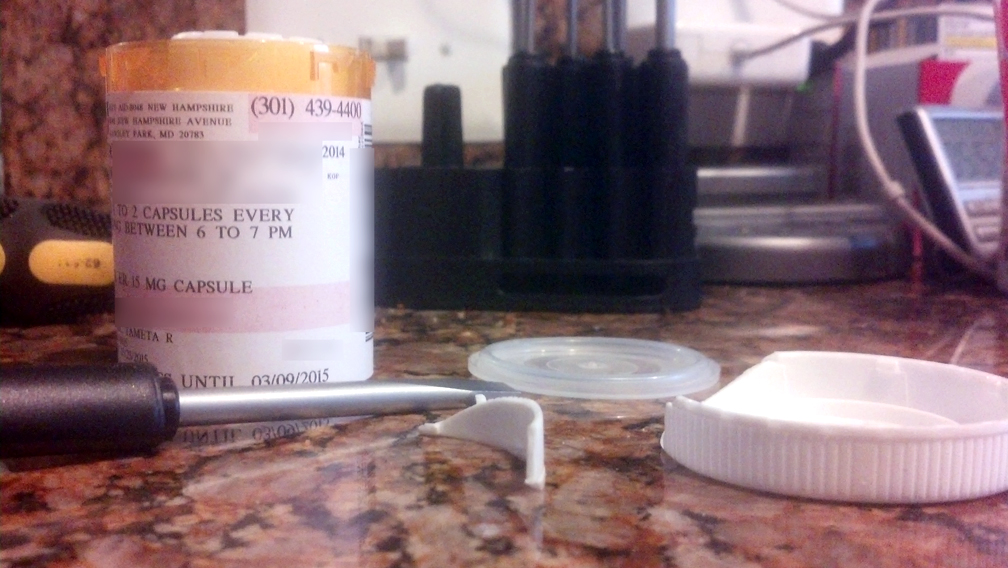
Now, if you look at the top of the orange bottle in the picture, you can see that the manufacturer’s bottle doesn’t actually fit inside the orange one all that well. (Looks a wee bit too tall, wouldn’t you say?) Anyway, it may have been possible for a healthy person, with two working shoulders, to exert enough pressure to get the press-down-and-turn lid off after you crammed it on there (possibly with help of a C-clamp). But you’d think it might be obvious that someone who gets her meds dispensed in the actual 180-pill bottle they’re stocked in may not be a healthy person capable of exerting sixty pounds of pressure onto a pill bottle in order to get the lid off of it.

Now, far be it from me to tell you how to do your job. We’re just talking here, right? But maybe, in the future, if you should run into this issue again, perhaps you could use a larger orange bottle, so I wouldn’t have to wedge a screwdriver in the cap and hit it with a hammer to get it off?

Better yet, if you’re trying to save plastic, maybe – call me crazy – you could just do away with the second bottle altogether and slap a label right on the original one. Just a thought. No big deal, really. I mean, we’re just talking here, right?

Posted in Aspect I | Tagged , , | 1 Comment

how bad is it, really?

It’s hard to imagine what it’s like to be in pain all of the time before it happens. Having a parent suffering from chronic pain, I tried, many times, and failed. It was as though my mind was unwilling to court such a scenario, even in my head, because it seemed like the most awful thing that could happen, and even imagining it was too much to handle. As depressed and angry as I get about constantly having to remind people that I need help, I don’t blame them for it. I’m jealous, in fact. I wish I could go reabsorb into my life and put this out of my head. I don’t want to dwell on it. I wish I didn’t have to.

Imagine your life is a TV screen, one of those old tube screens, where the corner would gradually turn green if you set it up too close to a speaker. That green spot in the corner is like chronic pain. When it only takes up the small corner, you can still enjoy the shows on the TV. It’s slightly annoying, but manageable, and sometimes you even forget it’s there.

But what if there is so much pain that the green spot fills half the screen, or more? You can’t see a lot of the show. You can hear things but without the visuals they don’t make much sense. You can’t follow the plot with so much information clouded from view, and after a while, it gets to be too much effort and you just want to turn the damn thing off.

That’s what my chronic pain is like. My pain fills a significant portion of my field of view, no matter where I am or what I am saying, doing, or thinking. There is no action, no observation, no thought or impression not crowded by that shadow. Sometimes it is small enough for me to pay attention to the world around me and experience being in my life, and I’m so grateful for those brief periods of respite. Other times, it is so bad that all I can do is lean back, close my eyes, breathe, and wait.

Yesterday morning I was so tired of this whole business that I wanted to flush my pain meds down the toilet. The last few nights have been awful. I awoke several times in the night to shooting pain from some sleeping position or another where my shoulder was pulled forward. I’m shivering, covered in sweat, and anxious from wild, traumatic dreams, all side effects from the pain medications. (The medication bonus pack also includes headaches, nausea, dizziness, a sour taste in the mouth, general muscle weakness, and disorientation that I try to pass off as occasional flakiness.) I just wanted to stop the whole thing. I feel like I’m on a roller coaster that never ends – it just keeps whipping me up and down and around, and I’m stuck in it and can’t get off.

Many days, I can’t tell where the discomfort from the pain medications ends and the pain begins. The pills just take the edge off. I have no idea how much because I don’t dare stop taking them, for fear of being completely incapacitated – of having the green take over the whole screen and shut me out of life completely. On days when I am late taking them, usually because I ran out of the house without them, not thinking (see disorientation, above), the pain takes over pretty quickly. Friday night I was driving home from a meeting, seven hours after the last dosage, my pain having devolved into unremitting agony. All I could do was scream, at the other drivers, the traffic signals, at God, for making me so miserable. I got home, sat down on the kitchen floor, and sobbed.

A few minutes later, tired of myself, I got up, took the meds, put an ice pack on my shoulder, and laid down to breathe, and to wait.

Posted in Aspect I | Tagged , | 1 Comment